

Behind every onchain transfer, whether it's a person moving funds or an agent rebalancing a position, a bridge is doing invisible work. Many users never think about which one.
Across Protocol has been building bridge infrastructure since 2021. In that time, it has processed over $35 billion in total volume across all integrations and never been exploited once. Not a single hack. Not a single user fund lost to a protocol-level failure.
That track record is why aggregators trust Across. And when you look at what Jumper Exchange's onchain data shows, the trust is well-placed.
What the Data Shows
We ran the numbers directly from Jumper's onchain data on Dune Analytics with help from the Jumper team. Across Protocol has processed $4.24 billion in all-time bridge volume through Jumper Exchange, more than any other bridge on the platform. Here's how the top bridges stack up:
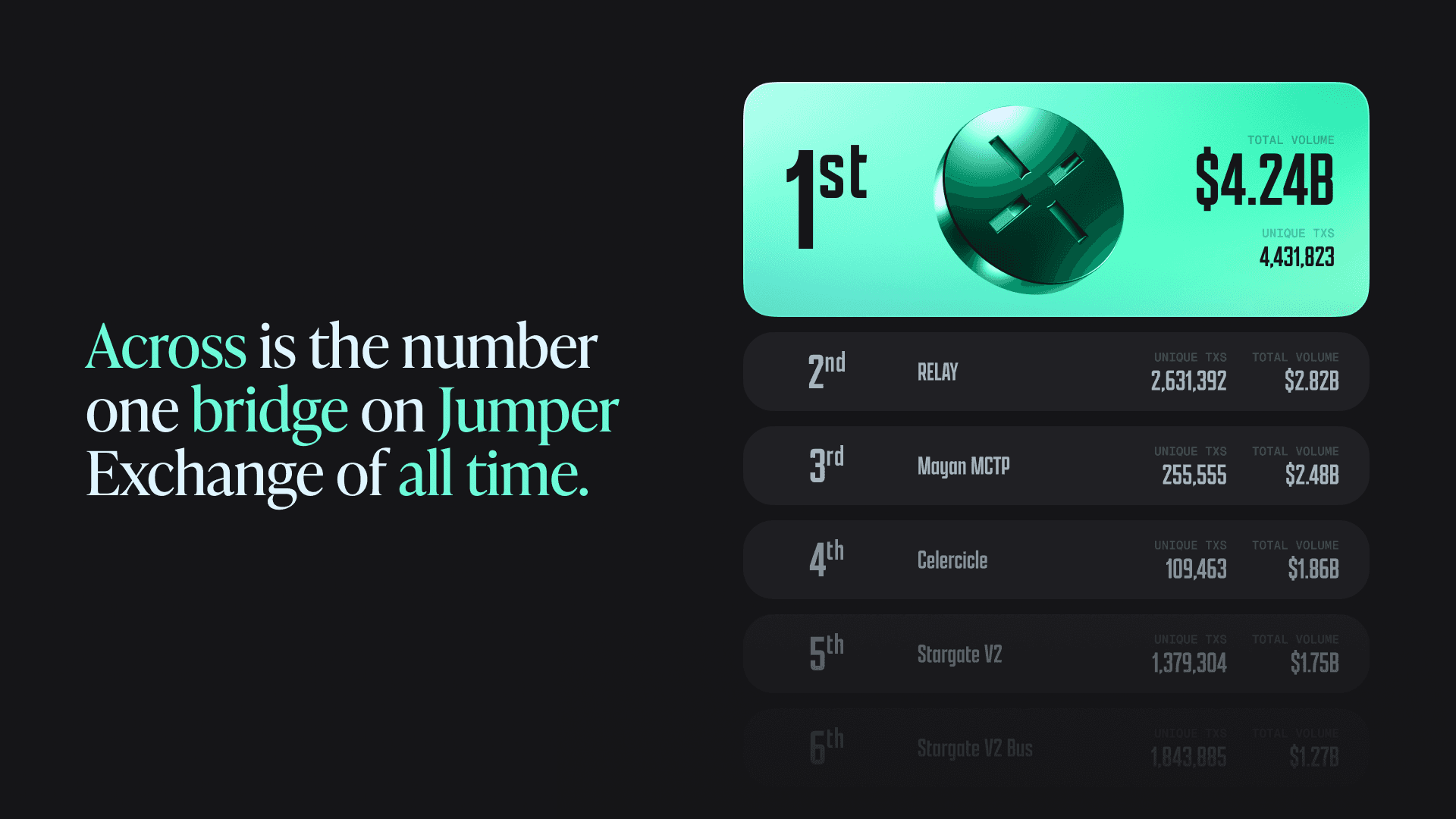
Across leads by over $1.4 billion, a 50% margin over the second-place bridge. And this isn't recent momentum padding the numbers. Across has maintained this position across Jumper's entire history, processing over 4.4 million unique transactions along the way.
Across Dominates the Routes That Matter
Volume leadership alone tells a compelling story. But when you break it down by destination chain, the picture becomes even clearer. Across is the top bridge for every major EVM L2 and Ethereum mainnet:
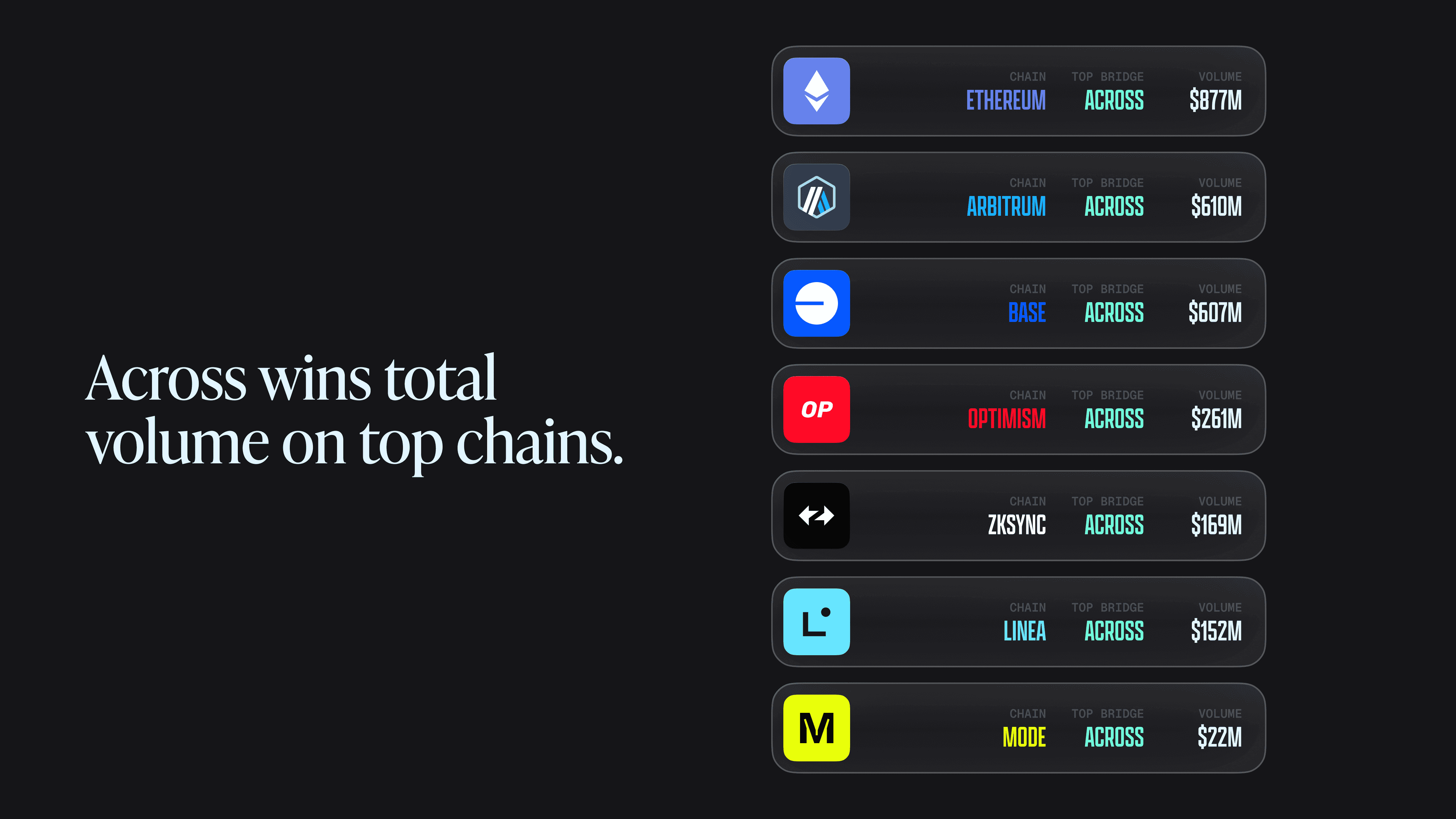
That's 7 out of the top 10 highest-volume destination chains where Across is the #1 bridge. The chains where other bridges lead are Solana (Relay), BNB Chain (cBridge), and Avalanche (Mayan), chains where Across either entered later or where non-EVM-native bridges have structural advantages.
For the routes that carry the most DeFi activity, Across is consistently the top performer.
Why Across Wins: The Intents Architecture
Across pioneered intents. Its architecture is fundamentally different from traditional bridges, and that difference translates directly into speed, cost, and security advantages that aggregators like Jumper can measure on every single route.
Intents, Not Transactions
Most bridges work by locking tokens on the source chain, passing a message, and minting or releasing tokens on the destination chain. This is slow, requires waiting for finality, relies on crosschain messaging, and introduces wrapped token risk.
Across flips this model. Users submit an intent, a signed expression of what they want (e.g., "I have 1 ETH on Arbitrum, I want 1 ETH on Base"). A competitive network of relayers races to fill it. The winning relayer fronts their own capital on the destination chain, delivering funds to the user in roughly 2 seconds. The user's experience is done. Settlement happens later, asynchronously, without the user waiting.
This is why Across consistently wins routes on Jumper: the aggregator evaluates bridges on speed and cost for every quote, and Across's intent-based fills are structurally faster than message-passing alternatives.
The Relayer Network: Permissionless and Competitive
Across relayers are independent operators who compete purely on speed. The network is permissionless; anyone can run a relayer. Risk Labs provides open-source relayer software, but operators can build custom implementations.
What started with 8 relayers is now a network of 52+ independent operators, an open market where the fastest relayer wins.
Relayers bear the capital risk during the fill-to-settlement window and earn fees in return. A key design detail: relayers can request repayment on any supported chain, not just the origin or destination. This lets them optimize their treasury across the entire multi-chain ecosystem, keeping capital efficient and fills fast.
A Security Record Built Over Years
The $35 billion in total bridged volume isn't just a big number. It's a stress test run across four years of live mainnet operation. Across has supported 24 chains, including Ethereum, all major L2s, and Solana (added August 2025 via V4's zero-knowledge proof system).
In an industry where bridge hacks have accounted for billions in losses, Across's clean record stands apart. Optimistic verification, permissionless dispute resolution, and the elimination of wrapped token risk combine into a security model that has proven resilient at scale.
The V4 upgrade (July 2025) introduced zero-knowledge proofs for universal chain verification, reducing the time to add new chains from weeks to hours. Across can scale to new ecosystems without compromising its security model.
Open Infrastructure, Not a Black Box
There are no gatekeepers in Across. Any relayer can participate. Settlement relies on an optimistic oracle and Ethereum L1 finality, not a trusted validator set or multisig. Anyone can challenge a fraudulent bundle, and are economically incentivized to do so.
This openness extends beyond the protocol itself. Across co-developed ERC-7683 with Uniswap, a standard for expressing crosschain intents that any protocol can build on. The goal isn't to own the bridge layer; it's to make fast, secure bridging a shared primitive for the entire ecosystem.
Making Interop Seamless
The multi-chain ecosystem will only get more complex. More chains, more routes, more demand for infrastructure that works without thinking about it. When a neutral aggregator evaluates bridges on speed, cost, and reliability for every route, the result is the data from Jumper: $4.2 billion in volume, #1 across every major EVM destination.
That's what four years of doing this right looks like.
Data sourced from Jumper Exchange Dune Dashboard using dune.jumper_exchange.result_lifi_bridge with help from the Jumper team. All figures represent all-time cumulative volume as of March 2026.